Monday, May 18, 2009

Review of Zaca Organic Hangover Patches

Well, I didn't have a hangover...

I received two free Zaca organic hangover patches for review a few months ago and have been anxiously waiting for a good time to try them out. These patches are exactly what they sound like - they are similar to the nicotine patches smokers use to quit except instead of nicotine they leech "hangover stopping" herbs and supplements into the bloodstream.

This past weekend presented the perfect opportunity to test the patches out - Sunday was San Francisco's Bay to Breakers. For those who haven't heard of Bay to Breakers, it is a "marathon" stretching from the San Francisco Bay to the Pacific Ocean. In reality, it is a seven mile walk filled with extravagant costumes, huge floats (many containing kegs) and enough alcohol consumption per capita to lay waste (wasted?) the entire route.

Since the race starts early in the morning, I put the patch on at around 8 AM. Almost immediately I felt a nice jolt - whatever herbs were in the patch really perked me up - I didn't even need my morning coffee. At around 9:00 I met some friends out in the street and started celebrating. As the day moved along, I continued to feel upbeat and energized (for the record, I did plan on recording my entire day for this review, but lost my camera sometime around 1 PM).


(Pouring one out for the homies)

The party started slowing down at around 1:30, but I stayed in the park with some friends until around 3:00. Still, I was disappointed; with this much time to recover before even going to bed, there was little reason for me to be hung over, patch or no patch. Determined to continue the experiment however, I left the patch on as we went out for food and then back to my apartment to watch a movie.

I was still feeling good at around 10PM that night and got into bed expecting no problems what-so-ever the following morning. "All in all," I thought to myself, "the hangover patches might actually be worth it." Then it happened. Out of nowhere: PANIC ATTACK.

I am not at all prone to panic attacks, so it took a few minutes before I even realized what was happening. All I know is that one second I was thoroughly enjoying my comfy bed, and the next I thought my heart was going to pop out of my chest and I couldn’t keep my thoughts straight. After trying some deep breathing and meditation to calm myself down (no success) I got up and washed the patch off. From that point on it took about an hour of pacing up and down my apartment and trying desperately to concentrate to bring myself back down. I ended up getting to bed at around midnight for about six hours of extremely fitful sleep.

Can I say for sure that these patches caused this random panic attack? No I cannot. However, the fact remains that I have never really had a panic attack before, and while this was my first time at Bay to Breakers, it was NOT my first time enjoying the San Francisco street party scene. Coincidence? It's possible. But let's just say I am in no hurry to put my second free patch to the test.

Images provided by Zacalife.com and The Green Dude himself

Tuesday, May 12, 2009

The Story of Stuff Gets NYT Shout Out

The Story of Stuff is an extremely well made, concise video from Annie Leonard and the good people over at Free Range Studios (also of Meatrix Fame), exposing the pitfalls of our uber-consumer society. This video has been around for some time, but I felt it deserved it's own blog post today since the NYT felt it deserved a full article in their lovely publication. The article is about how schools are using The Story of Stuff to encourage conversations in classrooms around the nation about rampant consumerism and its relation to environmental and social ills. Amazingly, most texbooks still make no mention of this fact, and at least one modern civics textbook mentioned in the article has only 3 paragraphs on global warming. In other words, this video is sorely needed, and I am glad it is getting the viewership it deserves. If you haven't seen it yet, please check it out for yourself:


I have said it before and I'll say it again: I have no inherent problem with "stuff." I don't necessarily share some environmentalists view that all stuff is bad. I happen to own several things (ie. "stuff") including but not limited to my bike, my computer, my comfortable bed and my snowboard, that I very much enjoy. In fact, while I am slightly more embarrassed about this, I even have a large TV that I have no immediate plans of giving up and that makes me very happy (especially when the Lakers are winning in HD).

That being said, buying stuff for the sake of having stuff, letting old stuff go by the wayside and throwing it in the trash so you can have new stuff, or just in general buying more stuff than you can possibly ever use is NOT GOOD. It is not good for society, it is not good for the planet, and it is not good for our wallets. "Stuff," like everything else, needs to be consumed in moderation.

Wednesday, May 6, 2009

Why We Need to Start Eating Lionfish

Apparently, thousands of lionfish have taken over large swaths of Florida's pristine coasts, decimating entire populations of native fish and corals. According to The Times Online:

"When Hurricane Andrew hit Florida in 1992, no one gave much thought to the six exotic lionfish that spilt into Biscayne Bay as the storm smashed their Miami waterfront aquarium.

Sixteen years later, thousands of the fish are wreaking havoc off America 's east coast, leading a potentially catastrophic marine invasion.

The highly poisonous hunter-killer, which is normally found in the Pacific and Indian Oceans , is the first non-native fish to establish itself in the Atlantic, where it is eating its way through other species faster than they can breed.

“They are eating almost anything that fits in their mouths,” said Lad Akins, director of special projects for the Reef Environmental Education Foundation (Reef). There could be, he added, “a severe impact across our entire marine ecosystem.”

With its needle-sharp spines and red and white stripes, the lionfish's hunting prowess is enhanced by the fact that other fish find them so baffling. “They kind of resemble a big clump of seaweed. Native fish don't see them as predators, or even as other fish,” said Mark Hixon, a coral reef ecology expert at Oregon State University. “That allows them to approach other fish and just slurp them up.”

The Hurricane Andrew Six are believed to be among several of the lionfish army's founding fathers. Private aquarium owners may have also dumped lionfish in the sea over the years, compounding their spread along the eastern seaboard and into the Caribbean. Studies by the National Oceanic and Atmospheric Administration show that numbers in some areas have risen from 22 per hectare (12,000 sq yards) in 2004 to 200 per hectare in 2008.

“Lionfish are eating their way through the reefs like a plague of locusts,” said Dr Hixon. “This may well become the most devastating marine invasion in history.”

Scientists are looking at why the lionfish is reproducing more rapidly in the Atlantic than in its native waters, hoping to identify a predator to keep numbers in check.

Reef is working on another solution: educating fishermen in how to catch them, and restaurants in how to prepare and serve them. “Lionfish are very edible,” said Mr Akins. “In fact, they are quite delicious.”"

Apart from the fact that several of the above passages are slightly more hilarious than any real journalist article has the right to be, this is definitely a problem. I happen to love lionfish - I think they look great in tanks, and I wouldn't mind at all running into a couple the next time I hit up the Florida Keys on a dive. I also happen to love eating fish. According to this article, I can have my fish and eat it too. I like the sound of that.

Wonder if they are as deliciously toxic as fugu.

Images provided by jayhem and

Tuesday, May 5, 2009

Government Incentives Can Be A Good Thing

This post is a little more political than I usually like to get (at least on this blog) but I just finished reading a great article on energy efficiency and why some direct government involvement is necessary to make that happen, and I thought the article deserved a shout out. You can read the full article and it's in-depth awesomeness here (Energy Efficiency), but the main points are that:
  • Resource intelligence (aka energy efficiency) is profitable. Study after study (after study) shows that homes and businesses have available a range of investments, technologies, and practices that cut energy use and pay handsome returns. (For example, this three-year study of efficiency in buildings.)
  • Resource intelligence isn’t happening on its own. Despite the aforementioned studies, people aren’t taking advantage of the opportunities at anything close to the available scale. The low-hanging fruit stubbornly remains unplucked. (Maybe because the people looking at that fruit aren't doing enough synergizing and social media research)
  • Resource intelligence is central to the climate/energy challenge. The International Energy Agency describes a scenario for achieving 450 ppm (the widely shared though likely inadequate target for atmospheric concentrations of CO2). Of the emission reductions they project, energy efficiency is responsible for 54%.
  • There’s need for public-private partnerships to restructure markets or create new ones. Market economics leads to a somewhat passive view of public life, wherein our collective welfare is entrusted to markets, to millions of allegedly rational individuals. But here we have a problem—the deterioration of the atmosphere—that presents us with great urgency, and a solution—resource intelligence—that requires our active intervention.
Basically, we have a situation where a 100% rational person would be investing in energy efficiency, but they aren't for any number of reasons, some good and some completely ridiculous. In order to get these people to make the decisions which are good for their health, their wallets and the environment as a whole, we need to educate them and/or give them some more incentives. Sounds good to you? Me too.

Thursday, April 30, 2009

Publishing Industry to Cut Carbon Emissions 20 Percent by 2020, 80 Percent by 2050

I used to work in the publishing industry, and while it was a super awesome place to work (as my homeboy Thomas Jefferson once said "I cannot live without books"), I was always bummed by the amount of waste we created every day. For example, we would have a pdf file of a first draft of a manuscript, and instead of e-mailing that pdf file around, my boss would have me print out a separate copy for each person who needed it (single sides, anywhere in between 100 and 300 pages).

Even worse, we didn't even have accessible recycling bins. There was literally one recycling bin on each floor, and people were too busy to go to it. They would just dump piles and piles of paper in the trash every day. And this was only for the first draft - same thing would happen with successive drafts, with the promo copies, and with the preview copies we sent for around for PR. And all of this before the printing of the actual book!

There are some "good" reasons for why we had to print all these copies out instead of sending pdf files. My generation is the first generation to really get used to spending more than 30 minutes reading on a screen, and even we are still slightly uncomfortable with it. My guess is that it won't be until the next generation that people are completely committed to online or electronic books. All of the higher ups, even in the publishing industry, just can't handle reading an entire manuscript on their screen.

A perfect example of this is the Amazon Kindle. Here is this amazing device, the same size as a book, where you can buy "books" for cheaper than in their paper versions and where you can carry 50 or so "books" around at the same time and in the same amount of space as a single book would usually take. People should be buying these by the truckload! And while Kindle sales are taking off, they are doing so very slowly and mostly with the younger generation. But I digress.

The fact of the matter is that people who grew up reading physical books still like reading physical books. They are uncomfortable reading them on a computer screen. The end result of this is that the publishing industry routinely cuts down 30 MILLION trees to make into the books that we buy each year.

There is some good news though: The Book Industry Environmental Council said today that it has set goals of cutting the U.S. book industry's greenhouse gas emissions 20 percent by 2020 -- and slashing them 80 percent by 2050.

While my problem with the publishing industry has more to do with the physical waste of paper than with overall CO2 emissions, cutting down on CO2 will also mean cutting down on paper waste. According to ClimateBiz.com, "the production, acquisition and use of paper are responsible for 65 percent of the U.S. book industry's carbon footprint. Increasing the use of recycled paper, ramping up the efficient use of all paper products, reducing returns and diverting books from landfills are among the steps that companies can take to reach the emissions goals."

It may not be perfect, but until we help out by doing all our reading electronically (something I admit I do not do, I LOVE my dog-eared paper books) it is a huge step in the right direction.

Thursday, April 23, 2009

Can Algae Outperform Other Biofuels?

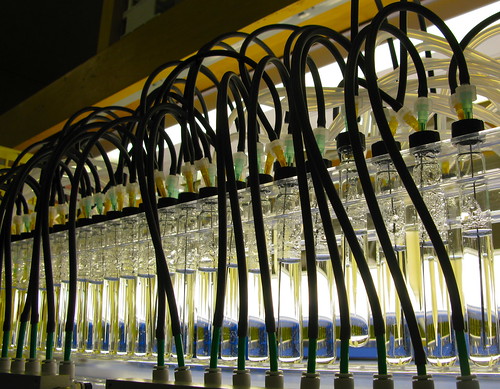
Here’s an article on the ever growing “algae revolution” where people stop chanting “drill baby, drill” and start chanting “grow baby, grow.” There are definitely upsides to algae, but do they outweigh the problems?

One group of people who say yes are the shrimp farmers in Gial Bend, AZ. Here, the newest algae project is not controlled by an army of scientists or funded with millions of dollars worth of government research grants. Rather, it's a desert shrimp farm changing with the times to produce biodiesel from algae, using some of the same algae that feed the shrimp.

With biodiesel prices at $4.81 a gallon, according to the U.S. Department of Energy, these shrimp farmers hope to produce it for less than $3 a gallon. With these small farms being capable of producing 5,000 gallons of biofuel per acre in two years, there is definitely something to be said.

Algae is transformed into biofuels by pressing the oil out of the algae and then adding lye, sodium and ethanol as a catalyst to make the fuel more pure. The lye, sodium and ethanol can be reused.

Biofuels made from algae have an advantage over biofuels made from soybeans, palm oil or corn because algae is not a source of food, growing algae does not use agriculturally fertile land and algae can be grown in treated wastewater.

FROM ALGAE TO FUEL

* Algae is turned into biofuel in a process called transesterification.

* Biofuels made from algae contain around 90 percent of the energy in regular diesel but produce less CO2.

* Some forms of algae consist of more than 50 percent oil.

* Many vehicles would not have to convert to run on biodiesel.

FUEL POTENTIAL

Biodiesel potential, according to a report from the University of New Hampshire :

* 7.5 billion gallons of biodiesel can be produced in an area of 780 square miles.

* Biofuels take advantage of solar energy because plants use photosynthesis to convert solar energy into fuel.

* Certain strains of algae are among the most photosynthetically efficient plants.

* 15,000 square miles of algae production could replace all the petroleum-based transportation fuels needed in the United States.

Now if I could only start selling the algae growing on my f*&#ing fishtank...

Image provided by jurvetson

Wednesday, April 22, 2009

San Franciscans - How to Get a Free Bike Rack

When the bike improvement injunction is lifted in mid-2009, San Francisco is planning on installing nearly 1,000 new bike racks throughout the city. Make sure you get one where it will help you.


The SFBC (San Francisco Bike Coalition) has a handy little form you can fill out to request your bike rack. Just go to the Fix It! page and submit the quick form to let the city know. All they need is the address or business name and street. The city still needs additional requests to meet their goal, so keep them coming!

Image provided by LancerE